
The morning the police came to my door, I thought my son had done something terrible.
That was my first mistake.
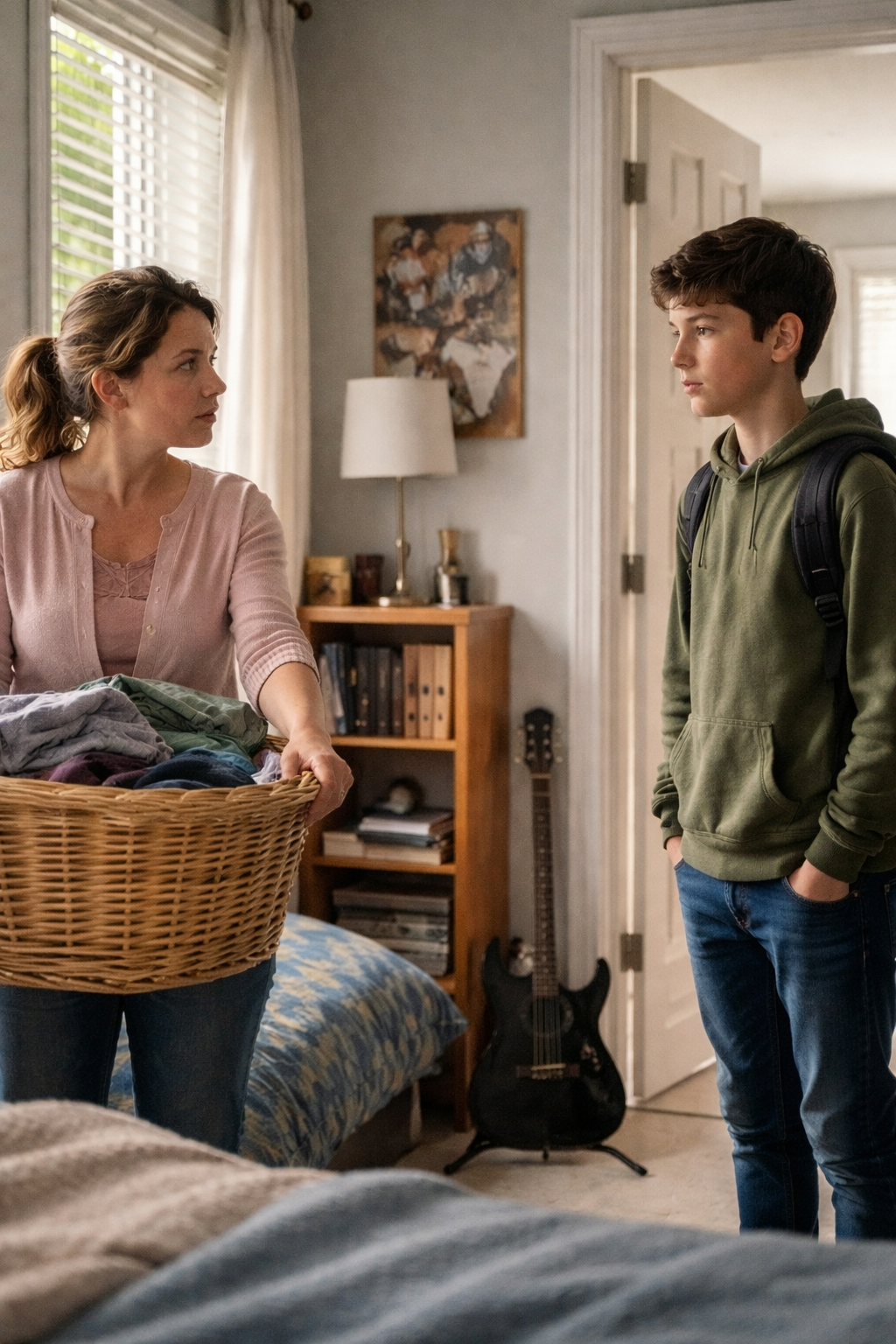
My second was assuming I’d known the full story a few nights before, when I walked into David’s room with a laundry basket on my hip and noticed the empty space by his desk.
His guitar was gone.
“David?” I called.
“Yeah, Mom?” he yelled from the kitchen.
“Where’s your guitar, son?”
“Mom,” he said, appearing in the doorway to his room. “I’m sorry I didn’t tell you…”
“David, what’s going on?”
He lowered his eyes. “I sold my guitar, Mom.”
“You did what?!”
I set the basket down on the floor because my hands had gone weak. “Why would you do that? That guitar meant everything to you.”
He swallowed. “It did. But Emily needed a new wheelchair.”
I just stared at him.
“Her old chair was barely working,” he said quickly. “The wheels kept sticking, and she kept pretending she was fine, but she wasn’t. She missed lunch twice last week because it took too long to get across the building.”
Emily was his classmate. She was a sweet girl with sharp eyes and a lovely smile, always with a book on her lap. She had been paralyzed after an accident when she was little—but I didn’t know her chair had gotten that bad.
“How did you even do this?” I asked.
“I posted the guitar online. Mr. Keller from church bought it.”
“You sold an expensive guitar to a grown man from church without telling me?”
“He asked if I was sure like… four times, Mom.”
“I was sure. I still am.”
I pressed my fingers to my forehead. My son was so earnest it made me want to cry and lecture him at the same time.
“Why didn’t you come to me first?”
He looked miserable. “Because if I told you, you’d want to figure out a grown-up way. Emily couldn’t wait. She needed it now.”
That landed hard because he was right.
I was practical. I made lists, stretched grocery money, compared prices. My son had skipped all that and gone straight to sacrifice.
“Did you get a fair price?”
“I asked for $1200. I got $850. But it was enough. I got it through the hospital. It’s paid for.”
I closed my eyes. It wasn’t reckless stupidity—he had thought it through.
“Are you mad?” he asked.
“I am shocked,” I said. “But I am so proud of you. And I am also mad that you sold something that valuable without telling me first.”
“That’s fair.”
“Come here.”
He hugged me, all elbows and thirteen-year-old awkwardness.
“You’re too much like your father,” I murmured.
“Is that good or bad?”
“Today? Inconvenient, expensive, and good.”
The next morning, he made me tea.
“It’s ready at the hospital, Mom. Can we pick it up and surprise Emily?”
“What about her parents?”
“I don’t think they can be mad. She needed it.”
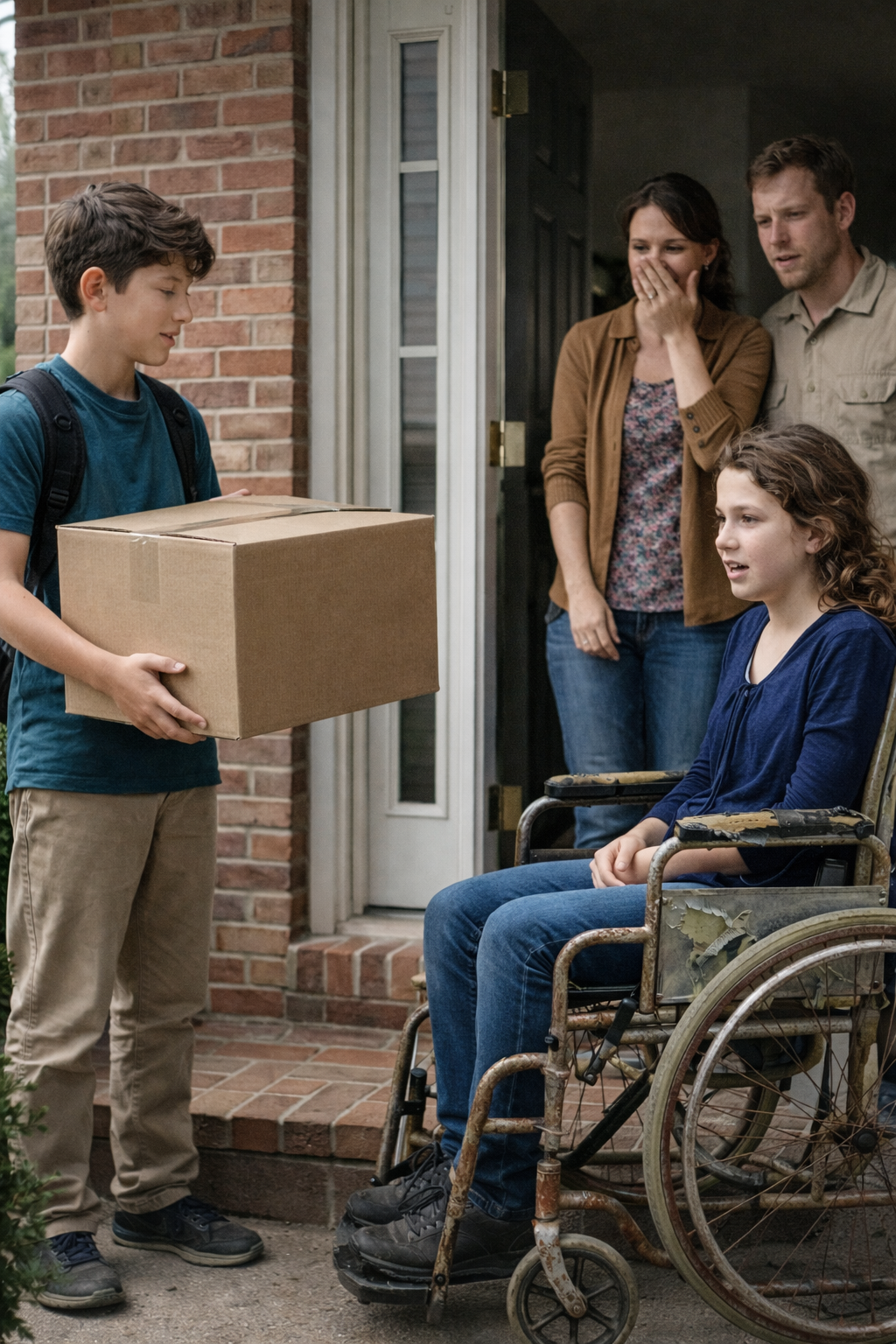
Emily opened the door in her old chair and froze.
“What’s that?”
“It’s a new wheelchair for you.”
Her eyes filled instantly.
Her mother, Jillian, came behind her and stopped too.
David stumbled over his words. “Your old one wasn’t working right… so I thought maybe…”
“You bought me a wheelchair?” Emily whispered.
“Yeah.”
“How?”
I answered. “He sold his guitar.”
Jillian covered her mouth.
Emily stared at him. “Why would you do that? You love playing guitar.”
David shrugged. “Because you needed it.”
Her father, Nathan, stepped in. He looked at everything, then at David.
“Son… you sold something you loved for my daughter?”
“Yeah, sir.”
“Thank you. Thank you, my boy.”
The next morning, someone pounded on my door hard enough to rattle it.
Two police officers stood there.
“Ma’am, are you Megan?”
“Yes.”
“Is your son here?”
My stomach dropped.
“Are you aware of what your son did yesterday?”
“He’s not under arrest,” one officer said quickly.
“Then why are you here?”
“Because what your son did reached people. Someone wants to thank him.”
We stepped outside. A patrol car waited. Nathan stood beside it.
“This isn’t about him doing something wrong,” Nathan said quietly.
We followed them to his house.
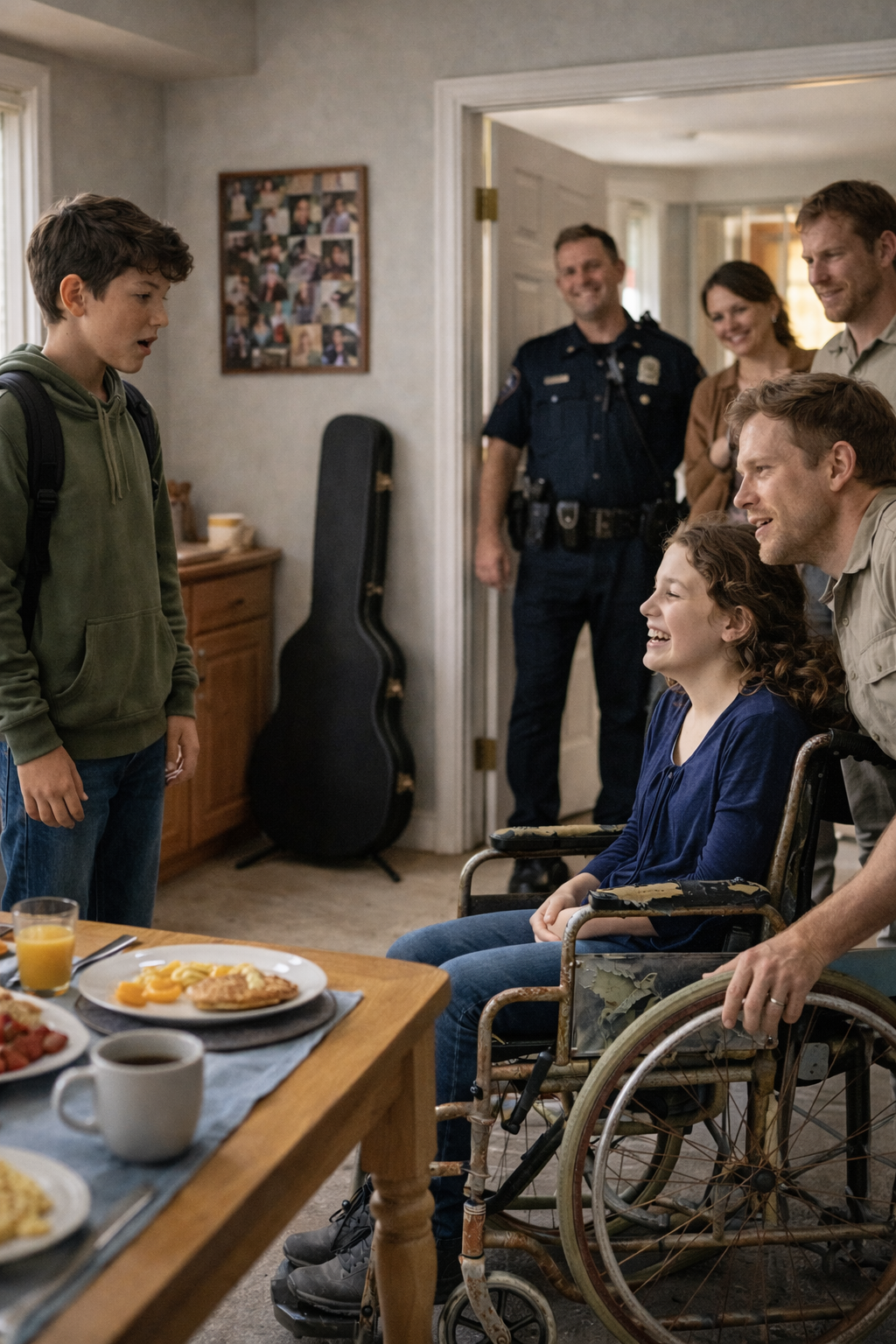
Inside, Emily and her mother were waiting. Breakfast was laid out—pancakes, eggs, fruit, coffee.
Emily’s new wheelchair gleamed.
And then I saw it.
A brand-new guitar case leaned against the wall.
David stopped cold.
Nathan spoke, voice rough:
“I found out how bad Emily’s chair had gotten. And that a thirteen-year-old boy sold the thing he loved most because he couldn’t stand watching her struggle.”
David flushed. “She needed it.”
Nathan nodded. “That’s why when I told the squad… they all pitched in.”
“Every officer on shift contributed,” one officer added.
Nathan swallowed. “I thought I was providing for my family. Meanwhile, my daughter was struggling—and your son was the one who saw her.”
“You didn’t have to do this,” David said.
“Yes. I did.”
Emily rolled up beside him. “And you better keep that guitar longer than twenty-four hours.”
David laughed. “No promises.”
“I’m serious!”
“Okay, fine. I’ll keep it.”
I stood there watching it all—my son, the officers, the breakfast, Emily smiling in her new chair, and a father trying not to fall apart.
I had been terrified the police came because my son had crossed a line.
Instead, they came because he reminded a room full of adults where that line should have been all along.
Later, at home, I found him sitting on his bed with the new guitar.
He strummed softly.
“Well?” I asked.
“It’s a really nice guitar, Mom.”
“That’s better than nice.”
He smiled a little and touched the strings like he couldn’t believe it.
He didn’t look proud.
He looked relieved.
And that stayed with me most—not that he was thanked, but that his kindness had shaken grown adults awake.
Source: amomama.com