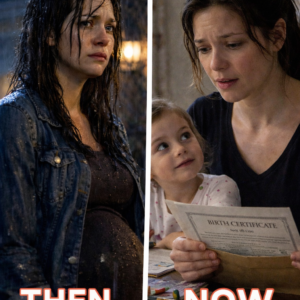

I wasn’t supposed to be back at Mercy Hill that early. But the second I pushed open the door to Room 218, my blood turned cold. My wife was standing over my mother, pressing a pillow down on her face.

“Adrien—wait,” she shouted, her voice shaking. “It’s not what you think.”
But in that moment, I wasn’t capable of hearing anything beyond what I saw.
My mother had been in that hospital bed for nearly two weeks. She was seventy-six, weak from pneumonia, thinner than I had ever seen her, and speaking in a voice that seemed to disappear more each day. I had spent every spare hour sitting beside her, adjusting her blanket, holding a cup of water to her lips, listening to her repeat old family stories as if she needed them to anchor herself.
She had raised me alone after my father died. She worked double shifts at a diner, came home smelling like coffee and grease, and still somehow made our tiny house feel safe. Looking after her now did not feel like duty. It felt like love returning to its source.
My wife, Marissa, came to the hospital too, but her presence was different. She showed up because she knew I expected it, not because she wanted to. That much had become obvious to me, though I tried not to say it out loud.
The tension between Marissa and my mother had been growing for years, then hardened when my business started failing. One bad contract turned into three. Payments arrived late. Debts did not. Marissa and I had to leave our apartment and move into my mother’s house “for a few months,” which turned into almost a year.
That year changed the shape of our marriage.
Marissa hated living there. She hated asking permission to use a kitchen that wasn’t hers, hated hearing my mother’s opinions about how money should be handled, hated feeling watched. My mother, for her part, had a way of making small comments sound harmless when they were not. She would mention how I liked my shirts folded. She would remind Marissa that I had always preferred quiet in the evenings. She would say things like, “In this house, we do things simply.”
None of those remarks sounded cruel on their own. Together, they built something cold.
I told myself it was ordinary family friction under stress. It was probably temporary. Money problems make everyone sharper at the edges. That was what I believed because the alternative felt too ugly.
Still, I noticed things.
Marissa began withdrawing in ways that were hard to name. She stopped talking freely when my mother entered the room. She slept lightly, as if she expected to be interrupted. She became careful with everything—her words, her movements, even the way she closed cabinet doors.
If my mother asked where she had been, Marissa answered too quickly. If my mother praised her for something, Marissa looked more tense afterward, not relieved.
I saw it, but I did not fully look at it.
I had my reasons. My business was still unsteady, and my pride was already damaged enough. My mother was giving us a roof. Marissa was exhausted, frustrated, embarrassed. Everyone had cause to be difficult. I told myself that was all this was.
Then my mother got sick, and the whole balance shifted again.
The hospital gave our conflict structure. Visiting hours. Shared concern. A role for everyone to play.
I became the devoted son. My mother became the fragile patient. Marissa became the dutiful wife standing quietly beside me, holding flowers she had not chosen, asking nurses polite questions in a voice that sounded too measured.
At first, I thought the hospital had softened things. But within a few days, that strange quiet between the two of them returned.
Once, I came back from the vending machine and found Marissa standing near the window, rigid, while my mother watched her from the bed with a small smile that vanished the moment I entered.
Another time, I heard my mother say, “You always were impatient,” in a tone so low and calm it sounded almost affectionate.
Marissa did not answer. She only stared at the floor.
“What was that about?” I asked later in the parking garage.
“Nothing,” she said.
It was becoming her favorite word.
Nothing.
Everything was always nothing.
The morning at Mercy Hill began with that uneasy pressure in my chest that had no clear cause. I woke before dawn and could not go back to sleep. My mother wasn’t due for any new tests. The doctor hadn’t called. Nothing had happened, and yet I felt pulled toward the hospital with the kind of urgency that makes logic feel irrelevant.
I drove through near-empty streets while the sun was still low and pale. The hospital parking garage smelled like concrete and rain. Inside, the hallways were unusually quiet. The fluorescent lights hummed overhead. When I reached the second floor, Room 218 was not fully closed.
I pushed the door open.
And saw my wife pressing a pillow over my mother’s face.
For one second, the world reduced itself to shapes and motion. My mother’s hands moved weakly beneath the blanket. Marissa leaned forward, her hair loose, her shoulders tense.
I lunged across the room and grabbed her arm so hard she cried out. The pillow slipped. My mother sucked in air with a terrible, ragged sound.
“What are you doing?” I shouted.
Marissa stumbled back against the wall, pale and shaking. “She couldn’t breathe,” she said. “Adrien, listen to me.”
But I had already called for help. Nurses rushed in. A doctor followed. There were questions, alarms, hands moving quickly around my mother’s bed. Someone led Marissa into the hallway. Someone else told me to sit down.
I did not sit.
I stood there, staring at my wife as if I had never seen her before.
She kept trying to speak to me, but I could not separate her words from the image in my head. Pillow. Face. My mother gasping for air.

It felt final.
A nurse later explained that my mother’s oxygen tubing had shifted and the pillow had been over her face only briefly. Briefly. The word changed nothing for me. The doctor’s neutral tone, the lack of immediate accusation, the absence of certainty—none of it mattered. Something had happened in that room that should never have happened.
Marissa was asked to leave for the day.
When I got home that evening, I expected guilt from her. Fear. An apology. Something direct and recognizable.
Instead, she looked exhausted.

“I was trying to reposition her,” she said. “She was panicking. She said she couldn’t breathe. I grabbed the pillow to prop her up and it slipped.”
“That’s not what I saw.”
“No,” she said quietly. “You saw the worst version.”
I wanted to reject that immediately, but something in her voice unsettled me. She didn’t sound defensive. She sounded finished.
That night, she slept in the guest room.
The next day, I returned to the hospital alone. My mother looked weaker, but alert enough to speak. She squeezed my hand and asked whether I was all right, which somehow made me feel younger and more ashamed.
“I should have listened,” she murmured. “I told you she resented me.”
The words slid into me too easily because they matched what I already feared.
Then she added, “Some people can hide themselves for years.”
I nodded. I hate that I nodded.
Over the next two days, people around us began reacting in ways that made everything worse. A nurse I hadn’t met before glanced at me strangely when Marissa’s name came up. My aunt called and said, “You have to protect your mother now.” Even my friend Caleb, who knew nothing beyond the basics, said, “If she could do that once, what else is she capable of?”
Their certainty fed mine.
And yet, underneath it, something small kept resisting.
It began with details I could not fit together. Marissa did not beg me to believe her. She did not try to rewrite the scene in dramatic terms. She just repeated the same thing with quiet steadiness: “You didn’t see what happened before you walked in.”
Then there was the social worker.
She stopped me outside the elevator and asked gently whether there had been “conflict at home” before my mother’s hospitalization. The question caught me off guard.
“What kind of conflict?”
She hesitated. “Your mother mentioned feeling unsafe sometimes, but she also made a few concerning comments about your wife. Comments that suggested control in both directions.”
I frowned. “What does that mean?”
“It means family dynamics can be more complicated than one moment in one room.”
I walked away irritated, but her words stayed with me.
That evening, I went back to my mother’s house to gather a few things. Marissa was not home. The place was still in that specific way a house becomes when someone has been anxious inside it for too long.
I went into the spare room where Marissa had been sleeping.
At first, I was only looking for paperwork. Instead, I found a notebook tucked beneath a sweater in the top drawer.

It wasn’t a diary in the dramatic sense. No confessions. No wild declarations. Just dates, short entries, and observations.
April 12 — She went through the laundry again. Told Adrien I forgot his blue shirt. It was in our room.
May 3 — Said maybe the business failed because I distract him.
May 19 — Changed the pantry shelves after I arranged them. Smiled when I noticed.
June 7 — Told me I should be grateful she “took me in.”
June 18 — I feel watched all the time.
The entries went on like that for months. Small incidents. Little humiliations. Things that would sound petty if said out loud but looked different in accumulation. By the last pages, the handwriting had changed. Less steady.
Hospital, Day 4 — She told the nurse I get confused easily.
Hospital, Day 6 — Said to me, “He always believes me in the end.”
I read that line three times.
Then I found the final entry, written the morning of the incident.
She pulled the oxygen tube loose and told me if I called for help, she’d say I touched her. I don’t know what she wants anymore. I think she wants me to break first.
I sat on the edge of the bed and stared at the page until the room blurred.
There are realizations that arrive like noise, and others that arrive in complete silence. This one was silent. It moved through every memory I had defended and rearranged them without asking permission.
The comments. The smiles. The way Marissa had gone still instead of loud. The way my mother always stayed just inside the line of plausible innocence.
I returned to Mercy Hill that night and asked to see the charge nurse. I did not accuse anyone. I only asked questions. Had my mother been removing her oxygen? Had there been remarks about my wife? Had staff noticed tension?
The nurse was careful, but careful did not mean blank. She said there had been “concerning interactions.” She said my mother seemed to become more distressed when Marissa was alone with her. She said they had already documented some inconsistencies.
Inconsistencies.
That word finished what the notebook had started.
When I finally found Marissa sitting in our car in the hospital garage, she looked at me the way people look at weather they no longer trust.
I stood outside for a second before opening the passenger door.
“I read your notebook,” I said.
She didn’t answer.
“I should have seen it.”
That was when she turned toward me, not angry, not relieved, just tired in a way that made me understand how long she had been carrying this alone.
“She wanted me to look unstable,” she said. “She knew if I ever reacted, it would be enough.”
I thought of Room 218. Of what I had seen. Of what I had not seen.
The truth was not clean. Marissa had reached a breaking point. My mother had been pushing toward one. Nobody in that story was untouched by damage anymore.
But only one of them had been believed without question.
I got into the car and closed the door.
“We’re leaving the house,” I said.
Marissa’s eyes filled, but she looked away before the tears could fall.
“And my mother won’t be alone with you again,” I added. “Not ever.”
It wasn’t a dramatic ending. There was no final speech, no clean justice waiting outside the frame. There were reports to make, arrangements to change, relatives to disappoint, and a marriage I would have to rebuild from a place of shame.
But for the first time in a long time, I understood the shape of the darkness beside me.
It had not been the woman I married.
It had been the one I trusted first.